

What are long-tail keywords and how would they function in search marketing? You're going to find out!
What Are Long-Tail Keywords, Exactly?
Long-tail keywords are longer and more unambiguous catchphrase expresses that guests are bound to utilize when they're more like a place to checkout or while they're utilizing voice search. Most long-tail keywords have lower search volume than short or "head" keywords. They're somewhat irrational, from the start, yet they can be colossally important assuming you know how to utilize them.

How Do Long-Tail Keywords Work?
Take this example: if you’re a company that sells classic furniture, the chances are that your pages are never going to appear near the top of an organic search for “furniture” because there’s too much competition (this is particularly true if you’re a smaller company or a startup). But if you specialize in, say, contemporary art-deco furniture, then keywords like “contemporary Art Deco-influenced semi-circle lounge” are going to reliably find those consumers looking for exactly that product.
Find your best long-tail keywords with our Free Keyword Tool.
Managing long-tail keywords is simply a matter of establishing better lines of communication between your business and the customers who are already out there, actively shopping for what you provide.
Think about it: if you google the word “sofa” (a very broad keyword sometimes referred to as a “head term”) what are the chances you’re going to end up clicking through to a sale? But if you google “elm wood veneer day-bed” you know exactly what you’re looking for and you’re probably prepared to pay for it then and there.
Clearly, you will draw less traffic with a long-tail watchword than you would with a more normal one, yet the traffic you improve: more centered, more dedicated, and more burning of your administrations.
Check out How to Leverage Content to 100x Organic Traffic
The 80/20 rule in long-tail keywords
The expression "long tail" is a visual similitude for the state of a dispersion diagram. Let's assume we were to make a diagram of far reaching watchword notoriety, a couple of words and expressions (Facebook, sex, Justin Bieber) would pile up a gigantic number of searches.
In any case, here's the astounding part: those catchphrase search terms, the "head" of the mythical beast, truly represent a shockingly little percentage of all pursuits, around ten to fifteen percent, contingent upon how you measure. One more fifteen to a fifth of searches come from mid-length keywords, implying that approximately over two thirds of online visits are the immediate consequence of - believe it or not - long-tailed keywords. It's a Chinese mythical beast: the tail continues endlessly and on.
Finding Qualified Searchers with Long-Tail Keywords
With shorter keywords, competition for rankings can be fierce, but visits can be scattershot and ROI can be low. With smart implementation of long-tail keywords, you may pull in less traffic, going purely by numbers, but the return on your investment will be proportionally much higher: you’ll be attracting exactly the audience you’re looking for, and that audience will be far closer to point-of-purchase than that of your less-savvy competitors.
Less Competition = Lower Costs
Long-tail keywords are valuable for businesses who want their content to rank in organic Google searches, but they’re potentially even more valuable for advertisers running paid search marketing campaigns.
That’s because when you bid on long-tailed keywords, the cost per click is inevitably lower, since there’s less competition.
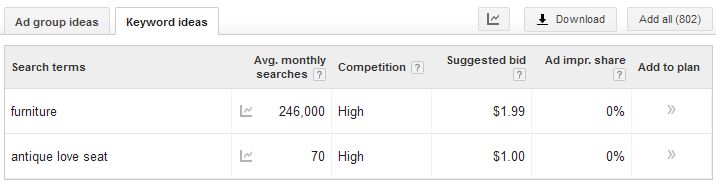
By targeting longer, more specific long-tail keywords in your AdWords campaigns, you can get higher ad rankings on relevant searches without having to pay a premium for every click.
The trick is to find a reliable, renewable source of long-tail keywords that are right for you and for your niche. Surprisingly, most keyword suggestion tools neglect this rich category, focusing only on the head, and ignoring the rest of the dragon.
So what are your options?
How to Find Long-Tail Keywords
It’s easy to find long-tail keywords with Google Keyword Planner Tool. Just enter the word you want to research:

Using long-tail keyword variations in your marketing campaigns is a win-win: better search rankings, more qualified search traffic, and lower costs per click.
Learn more about Five Digital Marketing Trends Every Marketer Should Know That Can Help Businesses in 2022
